

Thinking about entering IT but not interested in coding?
You are not alone.
Today, many professionals are looking at non-coding IT careers that involve business, communication, problem solving and leadership.
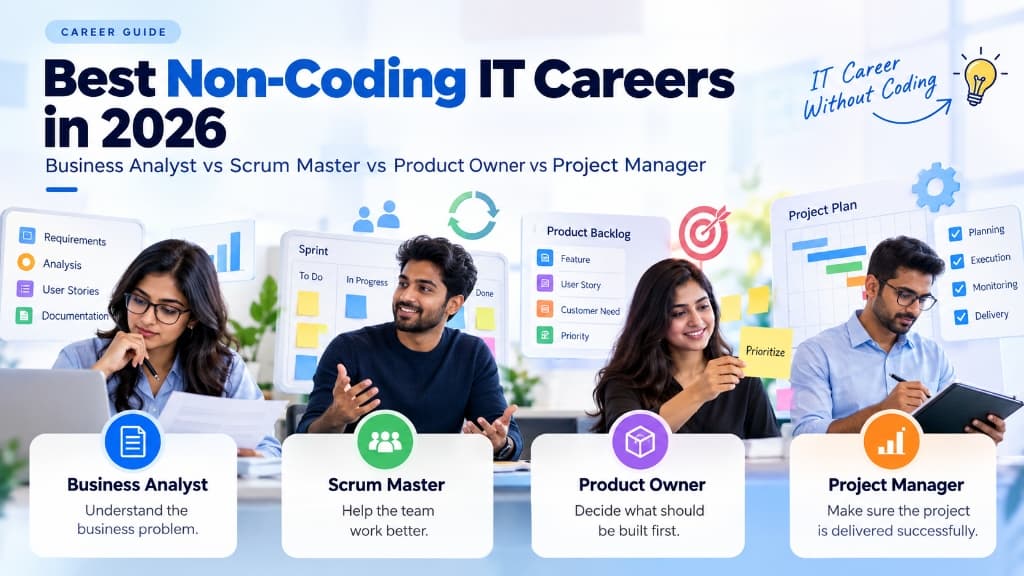
Four popular options are:
- ✓Business Analyst
- ✓Scrum Master
- ✓Product Owner
- ✓Project Manager
But these roles are NOT the same.
Business Analyst
A Business Analyst focuses on understanding the business problem and converting it into clear requirements for the technology team.
A BA may work on:
- ✓Requirement gathering
- ✓Stakeholder discussions
- ✓Business process analysis
- ✓User stories
- ✓BRD and documentation
- ✓Acceptance criteria
Best suited for: People who enjoy analysis, documentation and understanding business problems.
Scrum Master
A Scrum Master helps an Agile team work effectively.
The role includes:
- ✓Facilitating Scrum events
- ✓Removing impediments
- ✓Improving team collaboration
- ✓Coaching the team
- ✓Supporting continuous improvement
Best suited for: People who enjoy communication, teamwork, facilitation and problem solving.
Product Owner
A Product Owner focuses on what should be built and why.
The role includes:
- ✓Managing the product backlog
- ✓Prioritizing requirements
- ✓Understanding customer needs
- ✓Writing and refining user stories
- ✓Working with stakeholders
Best suited for: People interested in products, customers, business decisions and prioritization.
Project Manager
A Project Manager focuses on delivering a project within agreed scope, time, cost and quality.
The role can include:
- ✓Planning
- ✓Risk management
- ✓Resource coordination
- ✓Stakeholder communication
- ✓Schedule management
- ✓Project reporting
Best suited for: Professionals with project coordination or delivery experience.
Which One Should You Choose?
There is no single "best" career.
Choose based on your strengths:
- ✓Business Analyst: Understand the problem.
- ✓Scrum Master: Help the team work better.
- ✓Product Owner: Decide what should be built first.
- ✓Project Manager: Make sure the project is delivered successfully.
"Do not choose a career because someone told you it has a high salary. Choose a role that matches your strengths and then build the skills that the market needs."
For beginners, understanding the difference between these roles is the first step.
The right training should go beyond certification and help you understand real projects, tools, scenarios and interviews.