

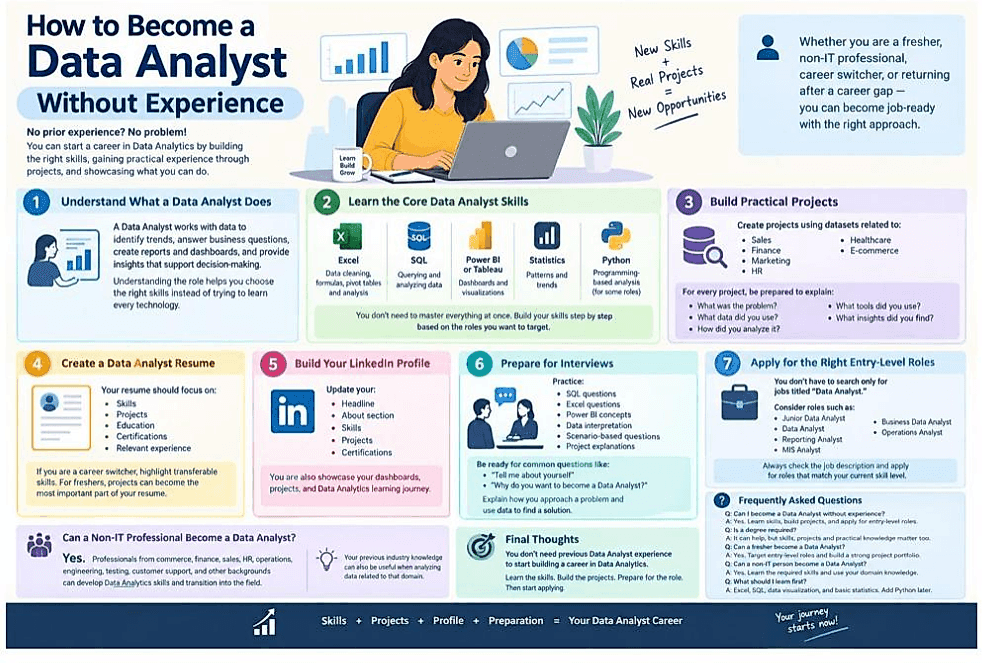
How to Become a Data Analyst Without Experience?
One of the biggest questions beginners ask is:
“Can I become a Data Analyst without prior experience?”
Yes. You can start a career in Data Analytics without previous Data Analyst experience. What matters is building the right skills, gaining practical experience through projects, and being able to demonstrate what you can do.
Whether you are a fresher, non-IT professional, career switcher, or someone returning after a career gap, you can follow a structured approach to become job-ready.
1. Understand What a Data Analyst Does
Before learning tools, understand the role.
A Data Analyst works with data to identify trends, answer business questions, create reports and dashboards, and provide insights that support decision-making.
Understanding the role helps you choose the right skills instead of trying to learn every technology.
2. Learn the Core Data Analyst Skills
Start with the skills commonly required for Data Analyst positions:
- ✓Excel – data cleaning, formulas, pivot tables and analysis
- ✓SQL – querying and analyzing data
- ✓Power BI or Tableau – creating dashboards and visualizations
- ✓Statistics – understanding patterns and trends
- ✓Python – useful for roles requiring programming-based analysis
You don't need to master everything at once. Build your skills step by step based on the roles you want to target.
3. Build Practical Projects
The biggest challenge without professional experience is demonstrating that you can actually work with data.
Create practical projects using datasets related to:
- ✓Sales
- ✓Finance
- ✓Marketing
- ✓HR
- ✓Healthcare
- ✓E-commerce
For every project, be prepared to explain:
What was the problem? What data did you use? How did you analyze it? What tools did you use? What insights did you find?
These projects can help demonstrate practical experience even when you don't have previous Data Analyst employment.
4. Create a Data Analyst Resume
Your resume should focus on your skills, projects, education, certifications, and relevant experience.
If you are a career switcher, don't completely remove your previous experience. Highlight transferable skills that can support your new career.
For freshers, projects can become an important part of the resume.
5. Build Your LinkedIn Profile
A strong LinkedIn profile can help recruiters understand your career direction.
Update your:
- ✓Headline
- ✓About section
- ✓Skills
- ✓Projects
- ✓Certifications
You can also showcase your dashboards, projects, and Data Analytics learning journey.
6. Prepare for Data Analyst Interviews
Don't wait until you receive your first interview call to start preparing.
Practice:
- ✓SQL questions
- ✓Excel questions
- ✓Power BI concepts
- ✓Data interpretation
- ✓Scenario-based questions
- ✓Project explanations
- ✓“Tell me about yourself”
- ✓“Why do you want to become a Data Analyst?”
You should be able to explain how you approach a problem and use data to find a solution.
7. Apply for the Right Entry-Level Roles
You don't have to search only for jobs titled “Data Analyst.”
Depending on your skills and background, consider roles such as:
- ✓Junior Data Analyst
- ✓Data Analyst
- ✓Reporting Analyst
- ✓MIS Analyst
- ✓Business Data Analyst
- ✓Operations Analyst
Always check the job description and apply for roles that match your current skill level.
Can a Non-IT Professional Become a Data Analyst?
Yes. A Computer Science or IT background is not the only path into Data Analytics.
Professionals from commerce, finance, sales, HR, operations, engineering, testing, customer support, and other backgrounds can develop Data Analytics skills and transition into the field.
Your previous industry knowledge can also be useful when analyzing data related to that domain.
Final Thoughts
You don't need previous Data Analyst experience to start building a career in Data Analytics.
You need to learn the right skills, build practical projects, create a strong profile, prepare for interviews, and apply strategically.
Professional experience may take time to build, but practical skills and projects can help you demonstrate your ability before you get your first Data Analyst opportunity.
Start with the skills. Build the projects. Prepare for the role. Then start applying.
Frequently Asked Questions
Can I become a Data Analyst without experience?
Yes. You can start by learning core Data Analytics skills, building practical projects, and preparing for entry-level opportunities.
Is a degree required to become a Data Analyst?
Educational requirements vary by company. A relevant degree can be helpful, but technical skills, projects, and practical knowledge are also important.
Can a fresher become a Data Analyst?
Yes. Freshers can target entry-level Data Analyst and related roles by developing relevant skills and building a strong project portfolio.
Can a non-IT person become a Data Analyst?
Yes. Non-IT professionals can transition into Data Analytics by learning the required technical and analytical skills.
What should I learn first to become a Data Analyst?
A good starting point is Excel, SQL, data visualization, and basic statistics. You can then add Python based on your target roles.