

Want to become a Scrum Master but do not have Scrum Master experience?
You may still have a strong starting point.
The important question is not:
"Have I worked as a Scrum Master before?"
The better question is:
"Do I have skills that can transfer into the Scrum Master role?"
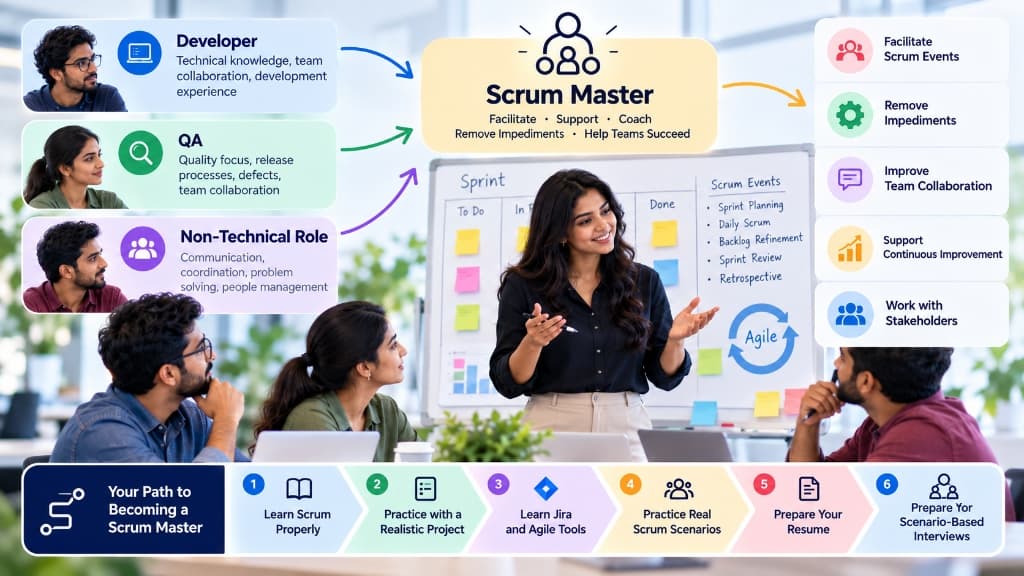
If You Are a Developer
You already understand software development and team collaboration.
You now need to build skills in:
- ✓Scrum
- ✓Facilitation
- ✓Servant leadership
- ✓Conflict management
- ✓Stakeholder communication
- ✓Impediment removal
If You Are in QA
QA professionals often understand:
- ✓Product quality
- ✓Release processes
- ✓Defects
- ✓Team collaboration
- ✓Testing dependencies
These can be exceptionally valuable when moving into Scrum.
If You Come From a Non-Technical Background
You can still learn Scrum.
Your strengths may include:
- ✓Communication
- ✓Coordination
- ✓Problem solving
- ✓People management
- ✓Business understanding
You will need to additionally understand how software teams work.
What About "Without Experience"?
This is where many candidates misunderstand the market.
You may not have Scrum Master job experience, but you can build practical Scrum experience through simulations, projects and real scenarios.
Practice:
- ✓Sprint Planning
- ✓Daily Scrum
- ✓Backlog Refinement
- ✓Sprint Review
- ✓Retrospective
- ✓Impediment management
- ✓Stakeholder situations
Then learn to explain what you would do in real interview scenarios.
"You cannot create experience overnight, but you can create evidence that you understand how the role works."
A Practical Roadmap
- ✓Step 1: Learn Scrum properly.
- ✓Step 2: Practice with a realistic project.
- ✓Step 3: Learn Jira and Agile tools.
- ✓Step 4: Practice real Scrum Master scenarios.
- ✓Step 5: Prepare your resume around transferable experience.
- ✓Step 6: Prepare for scenario-based interviews.
That is a much stronger approach than simply adding "Scrum Master" to your resume.